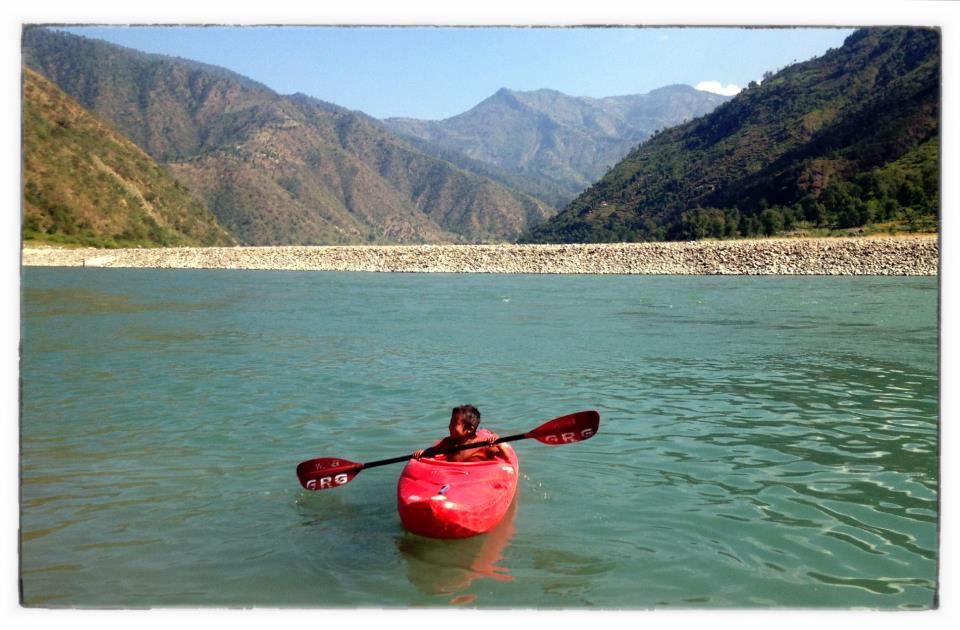
Months ago World Class made the decision to keep with
tradition, to not settle for the second best in our pursuit of
educational purity, to seek out and explore the world’s remaining wild
places, to research logistics and judge risk, to put in place an
ambitious plan, but one that was well within the skill level of our
organization. In short we decided that no Nepal semester would be
complete without the Karnali, that the heart of Nepal was the Karnali,
that without touching this heart our trip would be haunted by the beat
and rhythm of Nepal’s main organ that would mock us no matter where we
went or what we did. The morning of October 27 we put this plan into
action.
Day 1

Ziggy wakes up looks around and says, “Where are we at?” It’s 6:45 in
the morning and nobody answers him. We have been driving for about 16
hours and have entered the Karnali Zone, the largest district in Nepal
at roughly 5,000 square miles and the country’s most un-inhabited and
remote region. We stop at a small village, the first we have seen for
some time, and rub the sleep out of our eyes. Joints creak to life.
Weariness gets lifted from bodies and floats away with each successive
movement. We eat chickpea curry, hardboiled eggs, fried bread, and black
tea with milk. We are four more hours from the put-in.

As we near the river the road becomes steeper and steeper. After
cresting a ridge, we look down at a ribbon of blue-green water. This is
our first glimpse of the Karnali. Moments later the bus lurches to the
side; our first flat tire. We walk for a while as the tire is repaired
and examine the snakes, frogs, and unidentifiable bugs that are smashed
on the road, crouching low to get a better look to at the florescent
colors and black blood of the road kill.
We follow the switchbacks in the road for several more hours until we
get to the put-in, a sloping beach of white sand that we drive right
onto. The small village greets us as if they had been expecting our
arrival. Kayaks, rafts, and gear gets pulled off the bus and rigged for
the first time.
It is a short paddle down to our camp on river-right and spirits are
high as we take our first strokes on the Himalaya’s most notorious
river.
 Day 2
Day 2

We awake to tea and coffee as we watch the sun rise over the rocks of
the canyon wall, which stretches slowly towards us. We are getting our
systems in place, beginning the rhythm for the trip. A substantial
amount of dew makes everything quite wet and today will be the first of
many mornings where the team pulls tents and sleeping bags out to dry in
the sun. Luckily the days are hot. Maila, our Nepalese coach for the
semester and owner of
GRG kayaking, the company helping us organize this
trip, is pacing the sand near the river. He points out paw tracks.
“Tigers?” I ask, knowing that this is a notorious zone for these
endangered kings of the forest. “Maybe a small one,” says Maila.
We rig up and hit the river, which starts out with fun warm-up
rapids. Towards the afternoon we come up on our first big rapid and we
get out and scout from river right. Everyone has good lines and it is
the first time we get to feel the real power of the waves and holes that
will become so familiar by the time the trip is over.
Day 3
The Karnali is the longest river in Nepal, stretching from its
source, the glaciers of Mt. Mapchachungo, which feeds into Lake
Mansarovar located on the Tibetan Plateau, to Brahmaghat in India. Here
it confluences with the Sarda River, eventually becoming a tributary to
the Ganges.

On day three we awake to a crowd of children who have come out of the
hills to watch us go about our morning. We conduct classes under
watchful and curious eyes, eyes that have not had much opportunity for
learning. In 1971 the Karnali basin had a literacy rate of 7.5%. While
significant change has taken place, that percentage today is somewhere
around 50%. I wonder what these locals think about us, with our books
and notepads, sipping coffee and discussing apartheid South Africa and
graphs in Algebra.

Day three has some of the most consistent whitewater on the entire
run and the smiles are permanently drawn on all of our faces. We break
up the action by stopping in a small village for tea and suddenly become
transformed to what life was like 100 years ago.
Day 4
Today we get to some of the biggest rapids on the section. Around the corner we encounter
Gods House
a notorious rapid with a big hole in the middle that is best to avoid….
by anyone’s standards. This is a big test for our team and we spend a
while scouting it and discussing the lines, safety, and best angles for
video. We run it in three pods and everyone styles it… that is accept
for a pretty epic gear boat flip.
Whitewater continues on this day until camp, giving us some of the best canyons and rapids on the entire trip.
Day 5/6
We take a layover day on a beautiful beach under a rock cliff. A few
of the students and staff become sick with a 24-hour stomach bug.
Classes are conducted under the sun and we catch up on some sleep,
laundry, and bathing in the river.

Our Nepalese guides fish with nets from the kayaks, but only manage
to catch a few sardine-like specimens that soon get dissolved into the
dhal bhat. The next morning we slowly make our way down river to the
next camp. We pull our kayaks onto shore and begin unloading the rafts,
laying dry bags and gear out onto blue tarps so they don’t become
encrusted with sand. Some students begin setting up the kitchen, while
others start digging a hole for the communal outhouse. Just like that we
realize we have hit full-Karnali mode and all of us have think hard to
remember what life was like before.
Day 7/8
We have three gear rafts and 5 Nepalese guides + Joe from the UK.
They are extremely competent, hard-workers, great cooks, and big
personalities. Besides Mailia our host coach for the semester there is
the trip leader Gothan, Uttar, Ganesh, Santos, Sahja. They are wonderful
people to share this experience with and extremely thoughtful, often
times directly translating Nepali metaphors into English. One morning
while discussing teamwork on the river, Maila’s advice for the group
was, “it takes two hands to clap,” and to re-iterate his point claimed,
“there is a reason that we fry both sides of the bread.”
These days find mellow class II-III whitewater with great camping and
thick Himalayan sub-tropical jungle. On day 8 we are able to hike up a
side creek to a small waterfall with a jump rock. Nestled away in the
jungle foliage, it feels like a scene out of a Kipling story.
Day 9
We are beginning to feel the effects of being on a river for so long,
but spirits remain extremely high. We have emerged from the deeper
canyons of the river into a wider, more open environment with big
beaches and hot afternoons. Villages are becoming more and more frequent
and it feels like civilization is much closer. For the past 4 days we
had been asking villagers for either potatoes or onions. None were to be
found, an indicator of how difficult it is for these villages to grow
food.

On this night we held a memorial ceremony for Peter and Max, carving
their names into a pumpkin before launching it into the river. Both
would have enjoyed this trip and we still don’t understand why they had
to go.
Day 10
On the morning of the last full day on the water, we take our time
with breakfast and packing, enjoying the pink hue of the mist over the
river. On this day we are the big attraction around here and the
villagers have arrived early to observe us and then see us off. We have
now reached an area with a denser population and even some signs of
modernization (we can hear an engine of sorts… tractor?).
Students take turns rowing the raft as we are cheered on by excited
youth on both banks as we make our way down to camp. The Thule Bheri
confluence adds some flow to the river and we coast on down to stop in
an area with steep rock walls leading down the river. It is a
spectacular spot for the last night.

The Nepalese guides go into the village and get us a goat, which they
set about making curry with. This is our first fresh meat in some time
and the feast they prepare is glorious: Goat curry, rice, lentils,
pasta, white sauce, and fruit. Sitting around the campfire we swap
stories of our favorite moments on the canyon and enjoy the stars, the
people, and the night around us.
Day 11
Taking off a river after a long multi-day trip is an indescribable
feeling. Those who have felt it many times should feel lucky. It is a
mixture of relief, sorrow, reflection, anticipation, and usually quite
anti-climatic. One minute you are operating under the systems that we
call river life and the next you are crossing a street where Russian
tourists in army-green safari outfits follow you with their eyes as they
sip bottled water and wait for their ride to the nearby Bardia National
Park. There is trash under foot. Suddenly there are cars. A policeman
directs traffic with a whistle. Here there are no waves, no holes, no
jungle beaches, no bend in the river.
We un-rig the rafts and carry them up a flight of concrete stairs
that leads to the town. We pass under a giant sign denouncing poachers
and encouraging us to protect our “friends,” depicted by colored images
of a rhinoceros, tiger, Asian elephant, and of course the endangered
Gangetic River dolphin, the largest freshwater mammal found on the India
subcontinent.

The process of loading the boats begins and electronics are dug out
from the bus. Everything gets tied onto the roof and we change into
“street” clothes. Suddenly the pivotal moment occurs, which firmly,
definitively, and un-gracefully pulls us out of whatever river trance we
may still be in, and that sweet, delicious feeling of having escaped
the frantic motion that is the outside world comes crashing down as
Chase receives a bar of Wi-Fi on his cell phone. Without warning it
comes: Obama has been elected, Detroit got swept in the Series, a
hurricane devastated New Jersey and the Ducks won a shoot-out against a
very talented USC team.
We snap a group picture and literally jump onto the bus as its moving
away, avoiding some law about not stopping on the bridge while still
delivering a final team photo. And just as the river grew larger and
larger upon our arrival, so too did it become smaller and smaller during
our departure.
After a 19-hour bus ride, students and staff made it back to
Pokhara for the rest of the journey. The Nepalese guides spent another
nine hours getting back to Kathmandu. This is the first time World Class
has run the Karnali River.
Check out more photos of this trip here