Google GRG Adventure Kayaking, Rafting, Kayaking and Canyoning Adventures in Nepal

Saturday, 19 July 2014

What to do in Kathmandu...?


Many people land in Kathmandu, spend one night and then get out of the city as soon as possible. I can understand that, when's there's so many incredible mountains and riverswaiting for you out there...why would you waste your time on a busy, crazy city. But there's more to Kathmandu than you might have thought. 

For first timers to the city it can appear overwhelming. Crowds, heat, dust, traffic, noise...they weren't lying when they described it as a sensory overload. But get stuck in and enjoy the chaos, there's magic to this city you won't find anywhere else.

These are my top ten things to do in Kathmandu.

1. Visit the Monkey Temple, also known as Swayambbhunath. One of the top attractions in Kathmandu, once you manage to get up the 365 stone steps you will be greeted by an incredible view of the city and one of the best, most beautiful temples in the world. Sit and watch the world go by, just keep an eye on those cheeky monkeys!

2. Get foodie! One of the best things about staying in Kathmandu is to try out all the different restaurants. From local momo's to French cuisine, Mexican to Indian and some of the best pizza ever. You won't go hungry in this city!
See our full guide on where to eat in Kathmandu.

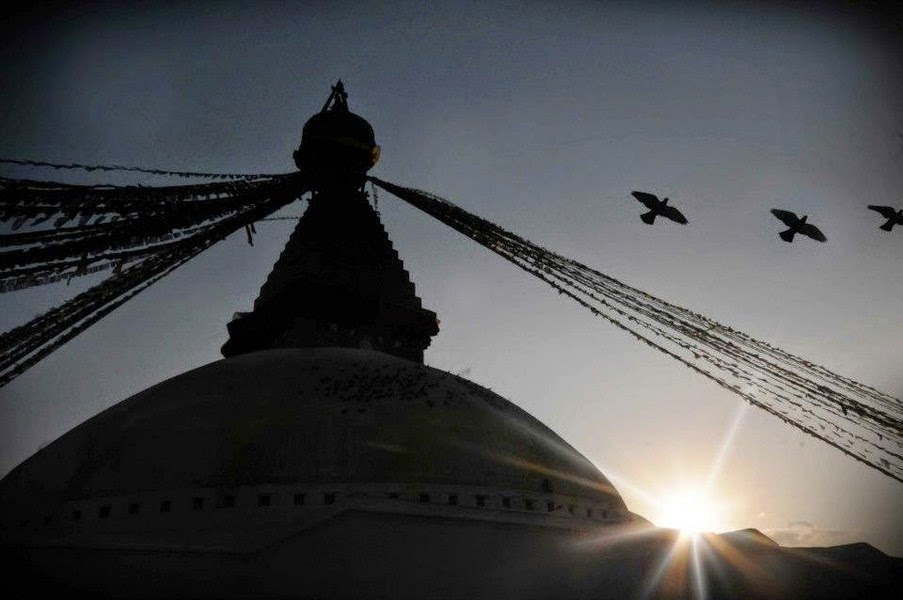
3. Watch the sun go down over Bodhnath Stupa. Bodhnath is the biggest Stupa in Asia and as such extremely popular with local Buddhists. The best time to go is around 5pm when all the locals are saying their mantras as they spin around the temple clockwise three times. Head up to one of the rooftop restaurants to see the sun dip down behind the temple - a truly magnificent sight.

4. Shop until you drop. Maybe not up everyone's street, but there are some great treasures to be found in Kathmandu. A favourite of mine is the Farmers Market that happens every Saturday at 1905, where they sell some scrummy food but also ethical clothing, jewellery and handicrafts.

5. Nightlife! A stay in Kathmandu wouldn't be complete with a trip to Tom and Jerries. Whether you like chilled out acoustic live music or heavy rock, there are bars and clubs to suit everyone's taste in Kathmandu. Just beware there is a curfew so when they say it's home time, they really mean it!

6. Get lost in Ashan Tol. The local market. Here you can find everything from fruits, kitchen ware, clothes, fresh fish and more! Get stuck in at this market and have a wander around the small backstreets of Kathmandu. But just one tip from you to me, keep a few rupees in your pocket in case you happen to get lost so you can make it back to the safety of your hotel!

7. Spend an afternoon in the Garden of Dreams. If your looking for a bit of peace then you found it. A small hidden garden on the outskirts of Thamel. It's worth the entrance fee of around 150 rupees just to sit in the garden to read your book and forget about the hustle and bustle going on outside the walls.

8. Take a mountain flight. If you don't have the time to trek to Everest, then taking a one hour flight around the mountains is the next best thing, Get up close and personal, the pilot will even let you in the cockpit to take photos.

9. Go Rock Climbing. Looking for a bit more adventure? Just a 20 minute drive from the center of Kathmandu is a great little rock climbing spot, called Nagarjun. For around $60 per day you can climb.

10. Spend a day wandering around Bhaktapur. Probably the most famous and most impressive of the three Durbar Squares (Patan and Kathmandu being the other two), it is worth the 30 minute drive to the ancient town of Bhaktapur. Whilst there make sure you try out the traditional curd and view their pottery.

If you would like more information on any of these ideas, then please feel free to email us info@grgadventurekayaking.com

Was this page useful for you? If so please share to help others!

Friday, 18 July 2014

The Tamur - Trekking and Whitewater at it's very best.


For us, the Tamur is a classic river trip. It combines world class whitewater with a stunning trek though the Himalayan foothills. Seriously, what more could you ask for in a holiday?! The ultimate adventure. 

This is a more technical river than the likes of the Karnali or Sun Kosi and has more continuous rapids, but is fairly similar to rivers such as the Bhote Kosi and Marysandi. For whitewater kayakers this means a whole lot of fun eddy hopping and for rafters it means one action packed holiday.


Located in the remote East of Nepal, the journey there is half the fun, either a 15 hour bumpy bus journey or a quick 45 minute flight followed by a shorter bus ride. Once you leave the hustle and bustle of Kathmandu, you won't see another tourist until your return. You'll drive through many villages giving you a real taste of Nepali life before we then start our three day hike at Basantapur; which has often been described as the most scenic trek in Nepal. Accompanied by local porters (you can breathe a sigh of relief that they will carry the boats for us!), the trek provides us with outstanding views of Everest, Makalu and Kanchenjunga which means 'five treasure houses of snow' giving you some idea what you can expect to see. A highlight of the trek is getting over the 10,000ft pass above the sacred lake whilst surrounded by the Rhododendron forests. And then we reach Dobhan and are greeted by the mighty Tamur River

Get ready for an epic whitewater rollercoaster ride.

131km with 120 rapids....

The rapids are powerful and continuous Class IV- V. But don't worry there are nice eddies the whole way down to catch your breath.

At night you'll be treated to 5 million star accommodation on secluded, remote white sandy beaches. Enjoy our famous rum punch around the camp fire and you'll have to wait just a few minutes before locals from the village come down when inevitably the singing and dancing around the campfire begins.

We'll also rustle you up a feast in the evenings around the campfire with some scrummy food such as rice, lentils, buffalo steaks, french fries, chicken curries and more. And if your lucky we'll source the locals favourite brew - Thungba - fermented Millet with hot water, trust me when I say it's much better than it sounds

Imagine waking up every morning to fresh Himalayan coffee, the mist slowly rising off the river to show you a sneak peak of the gorges above, your Nepali guides singing folk songs as they prepare eggs, pancakes, toast and fruit for breakfast before you set off down for another adventure.

The river continues, gaining power and we go down. Exhilarating rapids flowing through a narrow jungle gorge. And this trip isn't just about the whitewater (although believe me when I tell you that's pretty spectacular in itself). The scenery is just as incredible as the river.  For those wildlife lovers among you, you'll be able to see Monkeys, bird life including Himalayn Eagles, deer and if your really lucky Leopards and Tigers. We'll also paddle through a few remote villages where we'll be greeted by fisherman trying to catch dinner for their families, and children running through the rice paddies on their way to school. You'll get a glimpse into Nepali culture that you wouldn't see sticking to the tourist trails in Pokhara and Kathmandu.
The best section of this river is towards the end when the river turns West, creating Ocean sized waves like you've never seen before. On the last day of the river the Tamur joins the Sun Kosi where the river peters out and we have about a 30 minute flat paddle until we reach Chatra, our take out. After one last Dal bhat at our friends house, where we can also grab our first shower in over a week, it's back on the bus for our drive/flight back home

If this sounds like an adventure you would like to join, we have a guaranteed departure on the Tamur River headed out of Kathmandu on the 4th November 2014. Email us for more information.


What else do you need to know?

When to go rafting the Tamur - April- May is good as is the end of October - November after the river has fallen a bit after the monsoon. This is one to avoid during the monsoon months.

How to get there - All our trips depart from Thamel, Kathmandu. You have two options 1- Fly from Kathmandu to Biratnagar where we will collect you at the airport of 2 - Join the staff on the bus for the 15 hour drive.  


How much experience do I need? Kayakers should be solid Grade III- IV, but we can take beginner rafters who will be in the care of our expert rafting guides. If you are concerned about your paddling ability, email us and we can discuss further with you.


How do I book? Email us!!! info@grgadventurekayaking.com


Sunday, 13 July 2014

Top 10 Places to Eat in Kathmandu


Kathmandu is a food lovers heaven. You are treated to literally any variety of food you can imagine. Half the fun of staying in Thamel is to try out all the different restaurants and bars. To make navigating this town a little easier for you, I've listed our Top 10 favourite spots to for eating and drinking in Kathmandu.

  • Electric Pagoda - The best burger in town. That's all you really need to know about this place! It has a lovely garden with a variety of seating options, great cocktails and plenty to choose from the menu. Nice for lunch or a chilled out evening.
  • La Dolce Vita - Life is sweet. An Italian restaurant serving pizzas and pastas. The rooftop is one of the best places to spend a summers evening in Kathmandu. They also have a great wine list (which is rare for Nepal). This is the place we like to go to treat ourselves!
  • New Orleans - A funky blues restaurant right in the center of Thamel in a quiet garden. Their food is great (steaks, salads, burgers and more) and have quite an extensive drinks menu. Check out their schedule to see when they have a live blues band in the evenings. It's also a nice spot for an afternoon coffee (and ice cream!)
  • Northfields - My personal favourite breakfast spot. They have a variety of food on offer, Mexican, Nepali, Continental the list goes on. I like that they offer half or full sized portions on their breakfast menu, and the music from a traditional Nepali band in the evening sets a really great atmosphere. Coffee is refillable which is also great for breakfasts!
  • Road House - Pizza, pizza, pizza!! Beautifully cooked in a real stone oven in front of you, this is the best pizza place in town. The garden out the back is great for the hot evenings and in the winter they have patio heaters. A lovely place for a romantic meal or group dinner. And make sure you try their sizzling brownie at the end!
  • Muktinath Thakali Kitchen - Or as we like to call it 'Sunny Dal Bhat' as it's the only place in winter you can find sun in the city! This is a favourite amongst local business men who have their lunch time Dal Bhat here. There are other things on the menu, but their Dal Bhat is really something, and I have to be honest, I've never tried anything else!
  • Everest Momo - Hands down the best momo's in town, and our all time favourite lunch spot. There's no menu, you simply walk in, sit down and someone will bring you a plate of 10 buff momo's with a very tasty soup. The only choice you get is coke or fanta. You eat, you pay and you go. No hanging around. It's Nepal's equivalent of fast food, but so much better!
  • Yanling - If your looking for a cheaper place, Yanling serves nice momo's and Thupka (noodle soup) as well as fried rice and chowmein. It's not the fanciest place in town, but the food is good and service is quick.
  • Places - A vegetarian restaurant with a cool vibe. Ground seating, these guys have really worked out a unique and tasty menu. Their salads are the best in town. Another great lunch time spot or a very chilled out evening.
Did you find this article useful? Please share to help others!

Wednesday, 2 July 2014

Cultural Do's and Dont's when traveling to Nepal


Even if you have the best of intentions, when travelling to a new country is it often easy to offend people without even realising it. So here's my list of Nepali do's and don'ts I have learnt over the years of being in Nepal so you can learn a few of the local customs before you arrive here... Some are obvious and common sense, but a few are a little bit stranger!!
·         Always say 'Namaste' - the most common greeting in Nepal. Make sure you put your hands together in the prayer position when you say it.
·         Do not pat people on the top of their heads as this is seen as the most sacred part of the body.
·         Take your shoes off before entering a temple or some bodies home. When you do take your shoes off make sure they are facing the right way up (Nepali superstition!).
·         Don't touch food with your left hand. This is considered your dirty hand. Most Nepali people eat with their hands rather than cutlery.
·         Along the same lines...only pass money, and shake hands with you right hand. You shouldn't touch people with your left hand
·         When sharing a water bottle, you shouldn't let it touch your lips, but rather pour from above (this takes quite a bit of skill and practise but is a much more hygienic way of sharing water.
·         Do not point at a person (or statue) with a finger or foot.
·         Be careful with your feet! You shouldn't sit with your soles pointing at anyone, or step over someone seated on the floor.
·         Foreigners are often not allowed inside many Hindu temples, so make sure you ask permission before you entering.
·         It is common for Nepali's to slurp their tea. It is also common for them the spit and make a hacking noise from the back of their throats. Not something I have ever gotten used to , but it isn't considered rude.
·         Car horns are normal and actually make driving safer in Nepal. If you hear a horn, don't jump or do anything erratic, the driver is simply telling you that he is there and about to over take you.
·         Do not eat from another persons plate, it is considered rude.
·         If you visit a family home for dinner, it is normal for the mother to serve every one (several times!) and she will eat last when everyone else has finished.
·         People do not commonly use their names here, but rather there relationship to each other. For example you wouldn't call out 'Tom' but rather 'Brother' (Dai in Nepali)
·         Cover up. Make sure you dress appropriately, especially in places of worship. Even if it's hot, men should not walk around bare chested.
·         When women are menstruating they eat and sleep alone. They are not allowed to enter the kitchen or temples.
·         Haggling is common practice in many shops (although not for water, or in supermarkets etc). Be polite and enjoy it!
·         Be aware of 'Nepali time'! Things in Nepal move very slowly and it is not uncommon for people to be 30 minutes late. Relax, be flexible and enjoy the pace of life here.
·         No displays of public affection please between same sexes please! Although it is no problem for men to walk around holding hands.
·         Being called fat is not an insult. And you will hear it a lot, even if you are not fat. In Nepal, it is a compliment! (The word for fat is 'Motti' or 'Motto')
·         You will find it hard to get beef in Nepal (only in tourist restaurants in Pokhara and Kathmandu it is served) but the local alternative is Water Buffalo.
·         You will notice many people will answer a question with a 'head bobble', basically wobbling their head from side to side, this means they are in agreement with you.
·         Do not be offended if a gist you are given is left unopened. It is seen as impolite to open a gift in from of the person who gave it.
·         When visiting temples make sure you go around them in a clockwise direction.
·         Once you venture out of the main cities, you will most likely get a lot of stares. They are not being rude, they are just interested, so smile and be polite.
·         Any finally - Nepalese have many superstitions, try to follow them where you can; if you drop rice, do not walk on it, it is considered rude to the Hindu Gods. The number 3 is considered unlucky.  If going on a long journey your family will usually give you a blessing first and only travel on certain days. Many homes and shops will have dangling chillies and lemons to protect from bad spirits. You shouldn't cut your toenails at night.
If you think I've missed anything, feel free to email me on info@grgadventurekayaking.com and I can add them in! For more tips on what to do before you travel to Nepal have a look at our website. 

Did you find this article useful? Then please share to help others!


Monday, 30 June 2014

Nepal Visa's...What's the deal?


If you are traveling to Nepal, then unless you are an Indian or Nepali national you are required to have a valid visa.

These can be obtained in two ways.

  • 1 - Before departure
  • 2 - On arrival at Tribhuvan airport, Kathmandu.

If you opt for option 1, Click on the following links depending on your country of residence...
UK  - http://www.nepembassy.org.uk/visa.php 
USA - http://www.nepalembassyusa.org/visa.php
Australia & New Zealand - http://www.necan.gov.np/services.htm
Canada - http://www.nepalembassy.ca/
South Africa - http://www.dfa.gov.za

Make sure that you leave more than enough time for them to return your passport to you.

If instead you are going to get your visa on arrival you will need to make sure you have a colour passport photo with you and the correct amount of money with you in US$. (There is an ATM at the airport, but it is often out of service so do not rely on it). And a pen - you'll be lucky to find one at the airport!! 

Once you reach the visa hall, proceed to the 'Tourist without Visa' and queue. If you are lucky and there is no queue you will be out within minutes, however, depending on how many people are on your flight you may be waiting for up to an hour. To get a jump on the queue you can download the form here immi.gov.np/download/app1.pdf

The maximum duration visa you can get on arrival is 3 months, although tourists are permitted to stay up to 5 months a year (150 days). So if you wish to stay longer than your three months you will need to apply for an extension which can be done in either Kathmandu or Pokhara

Current Visa fees...

Type of Visa
Visa Valid for
Fee
Multiple Entry
15 days
£20/-
Multiple Entry
30 days
£35/-
Multiple Entry
90 days
£75/-


Entry points for visa on arrival in Nepal:
1. TIA, Kathmandu. 
2. Kakarvitta, Jhapa (East Nepal)
3. Birganj, Parsa (Central Nepal)
4. Kodari, Sindhupalchowk (North border)
5. Belahia, Bhairahawa (Sunauli)
6. Jamunaha, Nepalganju (Mid-West Nepal)
7. Mohana, Dhangadhi (Kailali, Far West Nepal) 
8. gaddachauki, Mahendranagar (Kanchanpur, Far West Nepal)

Other Questions:
Where can I extend my tourist visa? Kathmandu or Pokhara, Pokhara is quicker and easier if you are in that area. 
How much time does it take to extend? Usually you are in and out within the same day, but depending on how busy it is, you can expect up to a 4 hour wait. 
I'm going to be on a rafting trip when my visa expires what should I do? Make sure you extend your visa before you go otherwise you will have to pay a fine.

If you have any questions about applying for your visa then please feel free to contact us on info@grgadventurekayaking.com 

Did you find this article useful? Please share to help others!

Thursday, 26 June 2014

Top Tips on Responsible Travel


No matter what you are doing in your destination of choice, kayaking, trekking, volunteering, paragliding or simply chilling out and sightseeing; There are a few things that we can all do to avoid causing offence or harming the environment and to be a responsible traveler. Remember, your actions count. Here are up top tips to make you a more ethical traveler!!

·         Understand and respect local cultures, traditions and holy places. You would be mortified to think that you had offended anyone when you arrive so it's worth knowing some of the local cultures. For example in Nepal, it is rude to shake hands, exchange money or eat using your left hand (as this is your dirty hand), it is also frowned upon to touch children on the top of their heads and you should always take off your shoes before entering a monastery. Read more about Nepali cultures and etiquette. 

·         Buy locally - If you want to buy your own food or get some snacks, get out of the big western supermarket and buy straight from the market. It's the same produce and you will be helping small businesses survive. You will most likely get a better price and you get the fun of wandering around the markets and meeting locals.

·         Ditch the plastic- Many countries do not have recycling facilities and if your drinking 3 litres a day for 2 weeks that's a whopping 84 bottles that will end up in a landfill somewhere. Bring (or buy) a refillable water bottle and use it as much as possible. In Nepal, many shops now have clean drinking water that you can get from a jar for just 10 rupees a litre (half the price of buying a plastic bottle)

·         Ask before taking a photo- It's common curtsey. You wouldn't like someone taking a photo of you going about your day to day business, so ask. They may say yes they may say no. If they do say no, say thank you and walk away. Most people don't mind. But it's always nice to ask first.

·         Carefully think about the souvenirs you buy- Make sure the items you buy have a legal and documented history and that they aren't stolen and are safe to be exported. You should also make sure you are not supporting activities that damage the environment or are a result of illegal activity. Make sure you are not buying a souvenir made from ivory, endangered hard woods, ancient artefacts or endangered animals.

·         Respect the environment- Our main goal is to 'leave no trace'. When your trekking, stick to the paths, don't pick any flowers or damage any trees. If your camping out, consider carefully where you will put your campfire and only use drift wood so as not to encourage de-forestation.

·         Learn a little language and get involved! -  Start with 'hello' and 'thank you'. In Nepali 'Namaste' and 'Dhanybhad'. It makes a world of difference and people really appreciate it. Read our full Nepali Language Guide.


Read more about what we do as a company to be a responsible travel company 

Did you find this article helpful? Then please share!

Wednesday, 25 June 2014

When's the best time to visit Nepal?


When you ask the question, When is the best time to visit Nepal? Most people will quickly respond the autumn season during October and November. The mountains are clear, the weather is perfect and conditions are great, not too cold in the mountains or to hot on the flat plains. However we think that every season has something to offer...

Winter. December - Feb. At this time of year the mountains are still clear, but the temperature does drop considerably. For trekking you need to make sure you have the correct gear with especially if you are going to high altitude, and rafting is still possible but the rivers are at their lowest (and coldest) at this point so choose your river wisely and make sure you ask for a wetsuit! This is however the perfect time for a trip to Chitwan and you should spot more wildlife than at other times of the year.

Spring. March-May. This is the second busiest season in Nepal. The weather starts to warm a little making it pleasant for trekking, the snow on the mountains begin to slowly melt raising the rivers. it is also a great time for wildlife watching and a great time if you want to see all the Rhododendron forests in bloom. However, it can be quite hazy during this time so you may not get the best mountain views. This is a great time to learn to kayak as the waters start to warm up and the river levels are still low enough for beginners.

Monsoon June - September - MONSOON!!! The monsoon normally starts mid June but can vary year to year and continues on until around September. You'll be amazed the amount of water that falls down, but it doesn't rain all day every day...mostly just in the afternoons. It is extremely hot, often going above 30 degrees. The whole country turns green, loads of yummy fruits and veg will be for sale in the markets, the air is clean, however, mountain views will totally be blocked, it gets very humid, roads sometimes disappear as they are washed away, trekking paths will have more leaches than normal. A pre-monsoon trip on the Sun Kosi River around mid June can be great fun! or for experienced kayakers, or monsoon itinerary really packs a punch!

Autumn. October - November. The main tourist season and start of the dry season. Temperatures are perfect, mountains are visible virtually everyday making it the perfect time for trekkers, the rivers are at perfect levels following the monsoon making it the best time of the year for rafting and kayaking. The only drawback is that this is when Nepal is at it's busiest. But that can be great fun exploring the bars, meeting other travelers, joining group trips will be most easy at this time of year. You will also get to witness some of the best Nepali festivals (Tihar and Dashain).


No matter what time of year you come to Nepal, you can guarantee you will have a great trip.


Rough guide to the conditions in Kathmandu at different times of the year. Please note that this is a guide and conditions vary a lot depending on the region you are planning on traveling to.
JANFEBMARAPRMAYJUNJULAUGSEPOCTNOVDEC
TEMP MIN °C2471216192020191373
TEMP MAX °C181925283030303028272319
RAINFALL (MM)154123581222463733451553883

Did you find this article useful? Then please share!

Tuesday, 17 June 2014

It's the Monsoon!!!


It's that time of year again - the Monsoon is upon us! Many people are put of rafting and kayaking in the monsoon from rumours that all the rivers become unrunnable in Nepal, although this is true for several of the rivers, it is not the case for all of them. And we're here to tell you we're rafting ALL MONSOON!!!!

So join us this June-September on the Trisuli for 1-4 days activities, we've got rafting, kayaking and canyoning going from one beach camp and YOU are welcome to join!!

For Intermediate/Experienced kayakers we are now also offering our Monsoon Kayaking Itinerary, 5 days, 5 rivers, BIG volume! (Confirmed departure on the 4th August, guarenteed)

So get on the river this monsoon - it's the best way to cool down!